

The starting procedure of marine engines on ships requires several points to be taken into consideration. While it is necessary that none of these points should be missed, there are a few extremely important things that should be done without fail while starting these ship engines.
Ten of these important points (in no particular sequence) are as followed:
1. Lubrication of Main Engine: Start pre-lubrication of the engine well before starting the marine engine. For the main engine it should be started before 1 hour and for auxiliary 4-stroke engines at least 15 minutes in advance.
Related reading: Ship’s marine engine lubrication system
2. Check All Important Parameters: After starting the lubrication pump, check lube oil levels and all other running pump parameters such as cooling water pressure, fuel oil temp and pressure, control and starting air pressure etc. to ensure that all are in the accepted range.
Related reading: 10 practical tips to handle engine room pumps
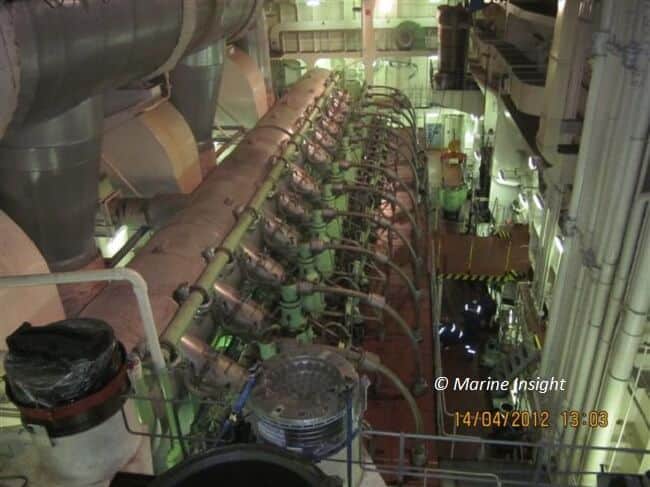
3. Open Indicator Cocks and Blow Through All the indicator cocks of the marine engine must be opened up for blow-through of the combustion chamber prior to starting in order to avoid hydraulic damage because of water leakage
4. Rotate the Crankshaft: Rotate the crankshaft of the marine engine by means of turning gear so that all the parts are thoroughly lubricated before starting.
Related Reading: Main Engine Operations: Running, Starting, Stopping
5. Manually Check Turning Gear: Ensure that the turning gear is properly disengaged by checking it locally even when the remote signal is showing-“disengaged” sign. Some auxiliary engines are provided with a tommy bar for rotation, ensure that it is removed from the flywheel before the engine is started.
6. Check Jacket Cooling Water Temperature: The jacket cooling water temperature of the engine should be maintained at least 60 deg C for the main engine and 40 deg C for the auxiliary engine (it may vary depending upon the KW rating of the engine).
Related Reading: General Overview of Central Cooling System Of Ships
7. Warm up the Engine: The incoming ship generator should be run at no load for at least 5 mins to allow warming up of the system.
8. Put Load Sharing Switch to Manual: When the 2nd generator is started, it will try to come on load as soon as possible due to the autoload automation provided for sharing the equal load (if same rated capacity).
While starting the 2nd generator, keep in mind to put the load sharing switch to manual. This will avoid the “just started” generator coming on load, giving it some time for warm-up.
9. Avoid Excessive Opening of Exhaust Valve: When starting the main engine with hydraulic oil operated exhaust valves, open the spring air first and then start the hydraulic oil to the exhaust valve. This will avoid the excessive opening of valves.
10. Examine the Engine: Responsible engineers of the ships to be present near the engine when it is started from a remote position. Auxiliary engine to be started from a local position (avoid using remote start if possible).
Smooth starting and stopping of engines not only depends on the systematic procedure but also on proper maintenance overhauling procedures of marine engines.

Do you know any other important points that should be considered while starting marine engines? Let us know in the comments below.
Disclaimer: The authors’ views expressed in this article do not necessarily reflect the views of The Marine Learners. Data and charts, if used, in the article have been sourced from available information and have not been authenticated by any statutory authority. The author and The Marine Learners do not claim it to be accurate nor accept any responsibility for the same. The views constitute only the opinions and do not constitute any guidelines or recommendation on any course of action to be followed by the reader.
The article or images cannot be reproduced, copied, shared or used in any form without the permission of the author and The Marine Learners.