
The field of merchant navy involves a certain order of hierarchy with the seafarers holding different ranks on ships. This ranking system ensures smooth coordination of onboard operations and promotes proper management strategies.
Being a line of work that requires a very high degree of professionalism wherein lax performance can result in drastic consequences, the hierarchy is essential to an economically viable model for shipboard operations with a shore-based support framework.
The nomenclature of the merchant navy ranking system is universally accepted by shipping companies and commercial vessels around the world.
The ranks and responsibilities that come with it are somewhat similar across the whole industry with minor changes in names and duties assigned to specific positions varying among shipping companies and the system of the nomenclature they follow. As mentioned above, essentially it is almost all the same.
In general, the ranking system on merchant vessels mainly divided into the following categories:
The bridge of a vessel is a hub that is fitted with critical equipment for the safe navigation and watchkeeping of the merchant ship.
Owing to the advanced and specific nature of the bridge equipment, a requisite skill set is imperative for an individual to control all the equipment and thereby safely navigate the ship.
Seafarers under the deck department of the ship are vested with the responsibility of managing ship navigation, along with handling cargo operations and berthing instruments present on the deck of the ship.
Related Reading:
Similarly, seafarers working in the ship’s engine room fall under the engine department. This mainly includes marine engineers and ratings responsible for operation and maintenance of ship’s machinery.
The engine room houses the part of the ship that fuels/propels the vessel altogether and needless to say, a specific set of skills is essential to the engine room personnel as well.
Related Reading:
The third department, or the catering department, is responsible for the preparation of meals and general housekeeping for crew and passengers.
The number of people employed in this department (which is under the purview of the Master, as with everything else) varies among ships and obviously, a passenger ship will have far more catering staff than a cargo ship owing to the number of people that need to be serviced.
A vessel thus requires a definite system of merchant navy ranks that would enable the distribution of assignments in a professional and formal manner.
The Captain (or Master) of the ship is the final authority of the ship and is the highest rank that one can achieve onboard. He shoulders total responsibility and oversees all shipboard operations.
The Captain is in command of a merchant ship at all times and regulates the proper daily transactions and handles the legal affairs on maritime issues.
In the unlikely event that the Master is not present on board, the Chief Mate is assumed to be interim in charge of shipboard operations.
Chief officer occupies the second responsible position after the Captain of the vessel. He is the executive head of the deck department and executes the order of the Master at the operational level (although the rank itself is a more managerial position).
He supervises the vessel’s crew and looks after the various deck operations which include, but not limited to the daily ongoings of the deck as per the work schedule as well as the cargo operations to be carried out while in port.
The Chief Mate prioritises the security and safe functioning of the vessel and is responsible for the welfare of crew and passengers (if on a passenger ship) on board.
Additionally, the correct working of the hull, the accommodation section, the cargo gearing, the security appliances and the fire prevention equipment is managed by the Chief Officer.
Chief among all of his duties is the safe navigation of the ship for which he is an OOW for the navigational watches between 0400-0800 hrs and 1600-2000 hrs.
Already burdened with a lot of work in the port, the Chief Mate usually does not keep port watches as he is constantly overseeing the cargo work.
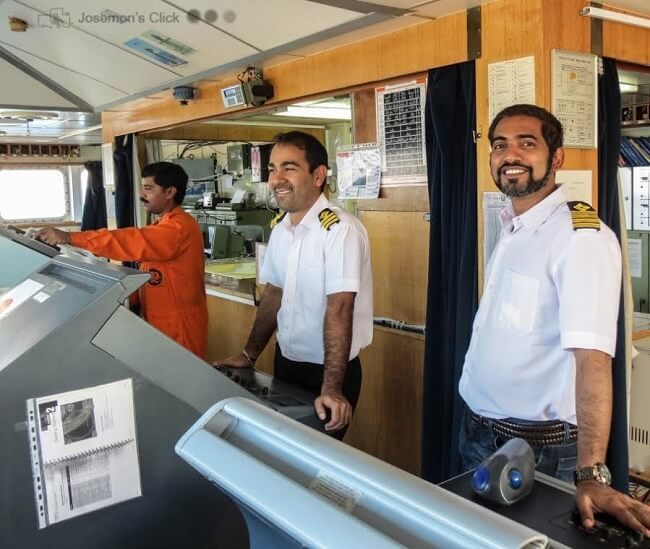
The 2nd Mate is an OOW responsible for the charts & publications on board and their maintenance. Also, he is the medical officer on board responsible for the upkeep and administering of all medically related services onboard.
Being an OOW, the navigational watch timings for him are 1200-1600 hrs and 0000-0400 hrs while at sea. In port, his watches are from 1200-1800 hrs and 0000-0600 hrs
The 3rd Mate is in charge of all the LSA and FFA onboard and is assigned the duty to upkeep and maintain them onboard. Apart from that, he has to handle all the port documents for use by the Master along with handling the bond store onboard.
Being an OOW, the navigational watch timings for him are 0800-1200 hrs and 2000-0000 hrs while at sea. In port, his watches are from 0600-1200 hrs and 1800-0000 hrs
The deck cadet is the trainee officer onboard, fresh out of the Institute. His sole job is to learn, comprehend and apply skills for the process of becoming a skilled officer in the future.
Being a fresh candidate, a cadet is assigned tasks that give him a gradual understanding of the ship and her ongoings which come to use when preparing for the “Certificate of Competency” examinations to assume responsibility as an OOW in the future.
Aside from the deck work that he needs to grasp, the major chunk of a cadets learning pertains to assisting an OOW in carrying out a safe navigational watch
Bosun is the head of the rating division on deck and carries out the scheduled work on deck in liaison with the Chief Mate
According to the modern nautical terminology, an able seaman (AB) possesses a merchant mariner’s document and is eligible to assist the deck department. Know more about the rank of Able Seaman here.
The post of an ordinary seaman, denoted by OS, serves the vessel’s deck department. An OS is usually busy with tasks such as buffing, scaling, cleaning the deck and occasionally painting the superstructure, above the main deck.
An ordinary seaman can undertake activities like overhauling, splicing ropes, wiring, rigging, etc and conduct repair work on the deck.
It is the Ordinary seaman’s job to ensure the secure handling of cargo gears and loading or dismantling cargo as directed by the Bosun/Chief Mate. A trainee OS is like a cadet but for the rating section. Know more about Ordinary Seaman here.
ChiefEngineerr is the head of the engineering department on a vessel. The required qualification for this position is loosely referred to as the “Chief’s Ticket”. Alternatively, he can also be alternatively termed as the “The Chief” and usually draws similar pay as compared to the Captain, although the complete responsibility of a particular vessel falls solely on the Captain’s shoulder. Chief engineer gives orders for operation and maintenance of ship’s machinery system and is responsible for the engine room department.
He is associated with the day-to-day activities in the engine room, and he is accountable to the Chief Engineer. Duties include constantly supervising the proper functioning of all engine room machinery systems and also assigns jobs to the other engine officers and crew. The Second Engineer generally keeps watch on the engine room, during the day time
Also Read: Duties of 2nd Engineer on Ship
This is the next position after the Second Engineer and is assigned jobs to look after machinery ordered by the chief engineer, along with daily watch keeping. He reports to the second engineer
This is the most junior rank in the engineering department. The Fourth Engineer is concerned about the correct working of the machinery systems assigned to him and also carry our watch keeping. He reports to the second engineer.
Also Read: Duties of a 4th Engineer on a Ship
Fifth engineer is a trainee under the Second Engineer officer, and he assists and learns while observing and carrying out activities in the engine room. He would accompany a senior officer (mostly second engineer) during the watch duty.
All the engine room ratings report to the second engineer. The engineering cadet spends his time on board with the chief objective of learning the requisite skills to becoming a competent engineering officer in the future (by clearing the requisite “Certificate Of Competency examinations to obtain the license to be a certified engineer)
Chief cook falls under the catering department of the ship. It is his duty to prepare meals regularly for the crew and passengers. He is also in charge of the food stores. The Chief Cook assists the Third Mate/Cadet in preparing the requisition for any/every food items to be forwarded to the company HQ to be procured onboard. The Chief Cook also inspects the equipment needed to keep the ship clean and uncontaminated in the galley area.
The trainee cook assists chief cook in preparation of meals and managing provision
The steward, as the name suggests, is assigned tasks include cooking and serving meals on time, sweeping and maintaining the living quarters of the officers, and stocktaking the stores. It is also the job of a steward to manage the grocery accounts, planning menus, and documents the cost control issues.
It is to note that a galley on passenger ships would involve several other ranks as well. Read here about galley jobs.
It is important to remember that while the shipboard hierarchy is almost the same across the industry, variations might exist depending on the nomenclature system followed in a specific company as well as the type of ship in question.
Having said that, the above gives a robust idea to the reader as to the existing norms with regard to the hierarchy in every department of merchant ships.
You might also like to read:
Disclaimer: The authors’ views expressed in this article do not necessarily reflect the views of The Marine Learners. Data and charts, if used, in the article have been sourced from available information and have not been authenticated by any statutory authority. The author and The Marine Learners do not claim it to be accurate nor accept any responsibility for the same. The views constitute only the opinions and do not constitute any guidelines or recommendation on any course of action to be followed by the reader.
The article or images cannot be reproduced, copied, shared or used in any form without the permission of the author and The Marine Learners.