
The shipping industry has come a long way as far as R & D for reducing costs of propulsion without increasing marine pollution is concerned. The conventional propulsion system of the ship is efficient but requires high operating costs and increases the marine pollution. Among all the prospective alternate power sources, electrical propulsion system is one of the best tried out alternative in today’s time.
The electric propulsion system consists of a prime mover which may be of two types:
Both the systems produce less pollution as compared to conventional marine propulsion system, which involves burning of heavy oil.
The propeller shaft of the ship is connected to large motors, which can be D.C or A.C driven and are known as propulsion motors. Power for propulsion motor is supplied by the ship’s generator and prime mover assembly.
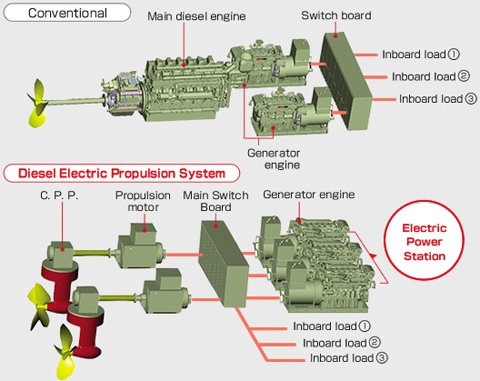
The generator can be direct or alternating current type with diesel or steam driven prime mover, depending upon the requirement or demand of the owner/ship.
In the electrical propulsion system, the direction of the rotation of propeller is governed by either the electrical control of the motor itself or by changing the electrical supply.
Normally variable speed electrical motor is used for fixed pitch propeller system and constant or variable can be used for variable pitch propeller or CPP.

Normally electrical propulsion is used in small vessel but now a day shipping companies are adopting this system for big size cargo vessel as well.
Generally electrical propulsion is fitted in
You may also like to read-What is Alternate Marine Power (AMP) or Cold Ironing
References:
Book on Marine Electro technology by H.D. McGeorge