Logbooks are an important part of daily routines carried out onboard ships as they help in keeping together all important records and parameters for future reference. Similar to the points discussed in our previous article on entries in bridge log book, it is important that ship engineers are also liable to maintain a separate Engine Room Log Book as part of their routine. In this article, we will discuss the important things that are to be mentioned in the engine room log book.
An engine room logbook is a track record of all ship machinery parameters, performance, maintenance, and malfunctions. The recorded values and information are used as a reference, to compare and record data to assess the ongoing performance of different engine room machinery.
The log book entries are very important during machinery breakdown and accidents are also taken as reference or evidence by the insurance company, surveyor etc. for the insurance claim if some accidents take place.
A responsible marine engineer Watchkeeper has to fill the logbook for his/her own watch period without fail, along with the signatures of all watchkeepers for their concerned watch timings.
Chief engineer also must countersign this book every day to make sure all the entries are being filled in it as per the company requirement.
In a manned engine room, during every watch machinery data is recorded manually taking the reading from the local gauges. It is a common practice that watchkeeper’s assistant for that particular watch (TME, Oiler etc.) has recorded all-important machinery local parameters. The entry of these parameters must only be done by the watch-keeping engineer and not by the assistant.
The following information must be written in a new logbook:
Ship’s name
International Maritime Organization (IMO) number
Call Sign
Maritime Mobile Service Identity (MMSI) Number
Port of Registry
Engine room team including all engineer officers and ratings
Following entries must be filled in the engine room logbook:
Date and voyage where the ship is heading
The position of the ship (at sea, at port or at anchorage)
Operation of MARPOL equipment with ship position in Lat and Long
Remarks and entries according to national and international rules and regulations; measures takes in the interest of sea-worthiness; safety of life at sea; care of cargo; safety of the vessel and environmental protection
Record the soundings of bilges/empty tanksEvery instance of behavior by an engine room crew inside the engine room, which may result in the dismissal of that seafarer or other disciplinary measures, including behavior involving violence, causing danger to any person, criminal damage, alcohol, or the use, supply, or possession of controlled drugs or the misuse of any prescription medicine
The presence of stowaway on board
Acts of piracy against the ship or acts of piracy witnessed against another ship
Interventions by a port state or coastal state affecting the normal operation of the ship, including detention of the ship for violation of safety or marine environment protection standards
Any kind of civil claims
Upon the arrival or departure of a vessel from a port, the present quantity of sludge/ bilge and fuel and lube oil quantity on ship must be recorded
Upon the departure of the vessel from every port, the quantity of fuel and lube oil received at port must be recorded
During the staying of a vessel in a port, the following must be recorded:
– Any spare or machinery part loaded or discharged.
– The receipt, if any, of fuel, and other supplies.
– Whether There were any crew change and name/rank of new engine room crew
Signature of the concerned watchkeeper
Signature of Chief engineer to make sure all entries are in position
Few things to be kept in mind while entering records/ data in ship’s engine room log book:
Time format in hours using four digits – 0001 to 2400
All entries must be in readable handwriting and must record all events clearly, briefly and accurately.
The duration of the voyage over the last 24 hours taking into consideration the hour change
A ship shall be required to preserve the official logbook for a period of 3 years after the last entry was made
If a wrong entry has been made, it should be corrected by single strike along with the signature of the Watchkeeper, who corrected the entry
The log book should be kept in the engine room and should be readily available for inspection demanded by:
– Company appointed Executive Office/ internal surveyor
– Class surveyor or insurance surveyor
– The port state authority at a port
Under the Maritime regulations, following acts by a ship staff are considered as an offence:
If a person destroys or mutilates an engine-room logbook or an entry in an engine-room logbook
If a person renders illegible to make an entry in an engine-room logbook
If a person makes a false or fraudulent entry in, or an omission from, an engine-room logbook
If a person signs an entry in an engine-room logbook knowing the entry to be false or fraudulent
Disclaimer: The authors’ views expressed in this article do not necessarily reflect the views of The Marine Learners. Data and charts, if used, in the article have been sourced from available information and have not been authenticated by any statutory authority. The author and The Marine Learners do not claim it to be accurate nor accept any responsibility for the same. The views constitute only the opinions and do not constitute any guidelines or recommendation on any course of action to be followed by the reader.
The article or images cannot be reproduced, copied, shared or used in any form without the permission of the author and The Marine Learners.



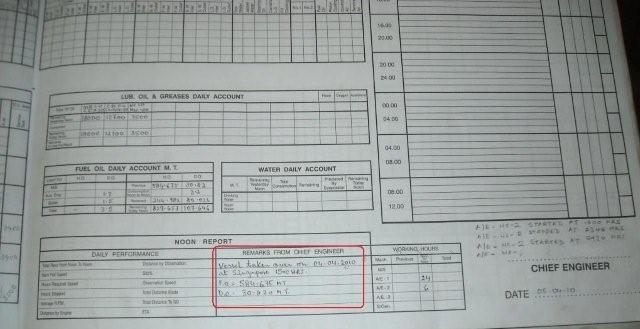 Readings and Parameters of Auxiliary Engine (Generators)