
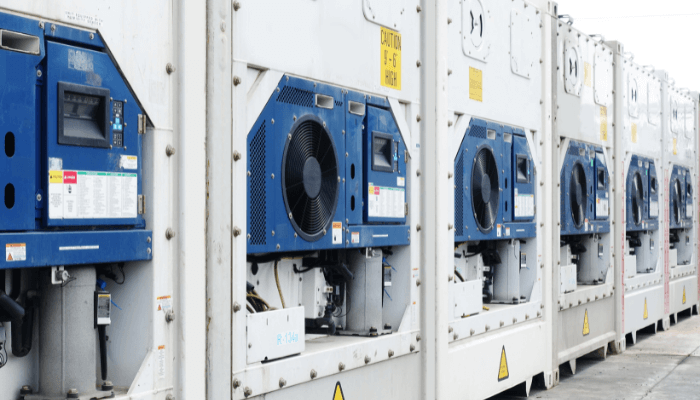
A reefer container is an enclosed unit used for transporting temperature sensitive cargo. The container requires an external power supply for its operation. The article describes everything you ever wanted to know about container refrigeration units.
When reefer containers are loaded in ships, the power supply is provided from the power generated from the D.G sets of the vessel. If the vessel’s generator capacity is not enough to support the additional power consumption of the refrigerated containers (in case of old ship or unavailability of generator due to overhauling etc.), mobile power packs are installed on the ship.

There are a different variety of refrigerated shipping containers present in the market today. A particular type is used depending upon the efficiency requirement and the cargo they need to carry.
Types of Refrigerated Shipping Containers are:
1. Closed Reefer: This is a conventional type refrigerated container. It comes in one-piece with integral front wall and an all-electric automatic cooling and heating unit for ISO sea-going containers.
2. Modified/ Controlled Atmosphere (MA/CA) reefer containers: These type of insulated shipping containers maintain a constant atmosphere by replacing consumed oxygen using an air exchange system, keeping an ideal atmosphere in equilibrium with the product’s deterioration rate.
3. Automatic Fresh Air Management Containers: Popularly known by its acronym – AFAM reefer containers uses advanced technology to regulate the air combination by automatically adjusting the scale of fresh air exchange. It works similar to Controlled Atmosphere refrigerated container, controlling the composition of oxygen, carbon dioxide and others. The controls of the AFAM refrigerated containers can be adjusted to influence and extend the shelf lives of the cargo they carry.
Some important points about container refrigeration are:
Related reading: How perishable food is transported using refer ships?
Understanding the Basic Sections of Refer Unit
1. Compressor Section
Related reading: What are safety devices on a refrigeration system of a ship?
2. Condenser Section
Related reading: Heat exchangers on ship explained
3. Evaporator Section
Related reading: Understanding capacity control in ship’s air conditioning and refrigeration system
4. Fresh air Make up Vent
Safety and Operating Precaution
An injury, no matter how small, should never go unattended. Always obtain first aid or medical attention immediately.
Most common Problem in refrigerated shipping containers – Leakage.
The leakage of refrigerant is the most common problem faced by onboard staff during the voyage. Following tests must be carried out to detect leakages:
1. Soap water test: This is done on low-pressure line by spraying soapy water on the troubled pipe or space. If the soapy water comes in contact with leakage area, bubbles will form
2. Halide lamp test: This is used for all pressure lines
3. Electronic leak detector: It is a portable unit to carry out leak detection. It should not be used in a noisy area.
4. Permanent or fixed type leak detection unit: Some reefer containers come with fixed type leak detection unit which gives audio-visual alarm in case of leakage
*Note: All the pipes in the refrigerated container unit are insulated. Before testing the piping for leakage, make a small hole in the insulation and check the leakage near the hole (using soap/ halide lamp or electronic detector). Once the leakage is confirmed, then remove the insulation of the complete pipe section to spot the leakage area.
Disclaimer: The authors’ views expressed in this article do not necessarily reflect the views of The Marine Learners. Data and charts, if used, in the article have been sourced from available information and have not been authenticated by any statutory authority. The author and The Marine Learners do not claim it to be accurate nor accept any responsibility for the same. The views constitute only the opinions and do not constitute any guidelines or recommendation on any course of action to be followed by the reader.
The article or images cannot be reproduced, copied, shared or used in any form without the permission of the author and The Marine Learners.